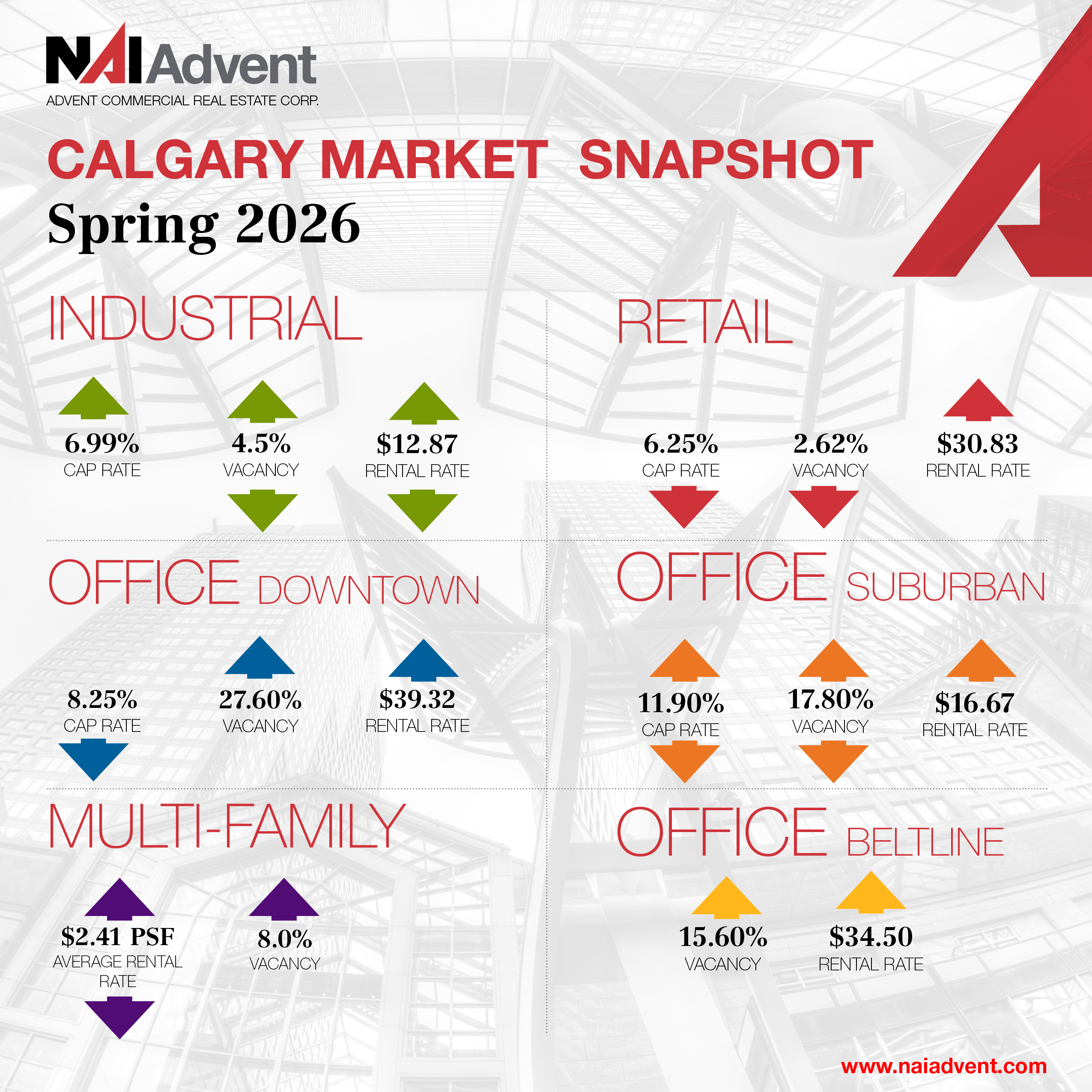
NAI Advent Releases Spring 2026 Calgary Market Report
Calgary’s commercial real estate market continues to evolve—and the latest NAI Advent Spring 2026 Market Report provides a clear view of where things stand today.
Backed by steady economic growth, strong population inflows, and a more disciplined development cycle, the market is shifting away from rapid expansion toward a more balanced and selective environment. While higher borrowing costs and global uncertainty remain factors, Alberta’s resilient energy sector and growing logistics and services base are helping to anchor demand across all major asset classes.
From industrial and retail to office and multi-family, Calgary is entering a phase where fundamentals remain strong—but strategy matters more than ever.
Calgary Industrial Market Remains Stable
The industrial sector continues to lead Calgary’s commercial real estate market, showing stability through Q1 2026.
Net absorption reached +149,592 square feet, moderating from late-2025 highs but remaining positive overall. Vacancy held firm at 3.46%, while availability remained near 4.30%, reinforcing the tight conditions that have defined the market in recent years.
Asking rents softened slightly to $15.29 per square foot, while overall market rents held steady—signalling a shift toward balance rather than decline.
Strong Fundamentals Continue to Drive Demand
Several key fundamentals are supporting Calgary’s industrial performance.
Population growth of nearly 3% year over year is fueling demand for goods, services, and logistics infrastructure. At the same time, improving labour conditions and projected GDP growth are reinforcing business confidence.
The city’s competitive position is further strengthened by its infrastructure, which provides efficient access to major transportation corridors, rail networks, and a 24/7 cargo airport. Combined with lower occupancy costs compared to larger Canadian markets, Calgary remains an attractive destination for industrial users.
A More Balanced, Competitive Market
After a strong run in recent years, the industrial market is transitioning into a more balanced phase.
Absorption has slowed, and landlords are becoming increasingly selective—particularly with larger spaces. Tenants, in turn, are taking a more measured approach to leasing decisions.
Rather than signalling weakness, this shift reflects a healthier, more sustainable cycle where supply and demand are better aligned.
Development Pipeline Remains Disciplined
New development continues, but at a controlled pace.
Major projects—including large-scale distribution facilities and build-to-suit developments—highlight ongoing confidence in Calgary’s industrial sector. However, much of the pipeline is either pre-leased or phased, meaning it will not significantly impact vacancy in the near term.
This disciplined approach to development is helping maintain tight market conditions while supporting long-term growth.
Demand Led by Logistics and Distribution
Leasing activity remains strong, particularly among users in logistics, distribution, and supply chain.
Calgary’s role as a Western Canadian hub continues to expand, with demand spanning retail distribution, consumer goods, and manufacturing. At the same time, availability remains especially limited for small- to mid-bay industrial space, keeping competition high in this segment.
Industrial Land Supply Remains Constrained
One of the defining features of the market is the ongoing shortage of serviced industrial land.
In key areas such as southeast Calgary and the Balzac corridor, limited supply and lengthy development timelines continue to push land values higher. Developers are responding by prioritizing build-to-suit and phased projects, helping to manage risk while maintaining steady absorption.
These constraints are expected to persist, supporting long-term value across the industrial sector.
Submarket Highlights
South Central Calgary remains one of the tightest industrial areas, with low vacancy and strong demand for centrally located, functional space.
Southeast Calgary saw a short-term pullback in Q1 due to large-format vacancy returning to the market, but underlying demand remains intact, and the area is expected to rebalance.
Northeast Calgary continues to lead the market, driven by strong absorption, rising rents, and its role as the city’s primary logistics hub—particularly in areas like Balzac.
Outlook: Stability with Opportunity
Looking ahead, Calgary’s industrial market is expected to remain stable through 2026.
Demand will likely continue at a more normalized pace, with vacancy holding steady and rents remaining relatively stable—especially for modern, well-located product.
For investors and occupiers, the opportunity lies in understanding this shift toward balance and positioning accordingly.
Explore the Full Report
For a deeper look at Calgary’s commercial real estate landscape—including office, retail, and multi-family insights—view the full report here:
👉 https://www.naiadvent.com/nai-advent-spring-2026-market-report/